The Green party has outgrown its own conference
By Liam Jones
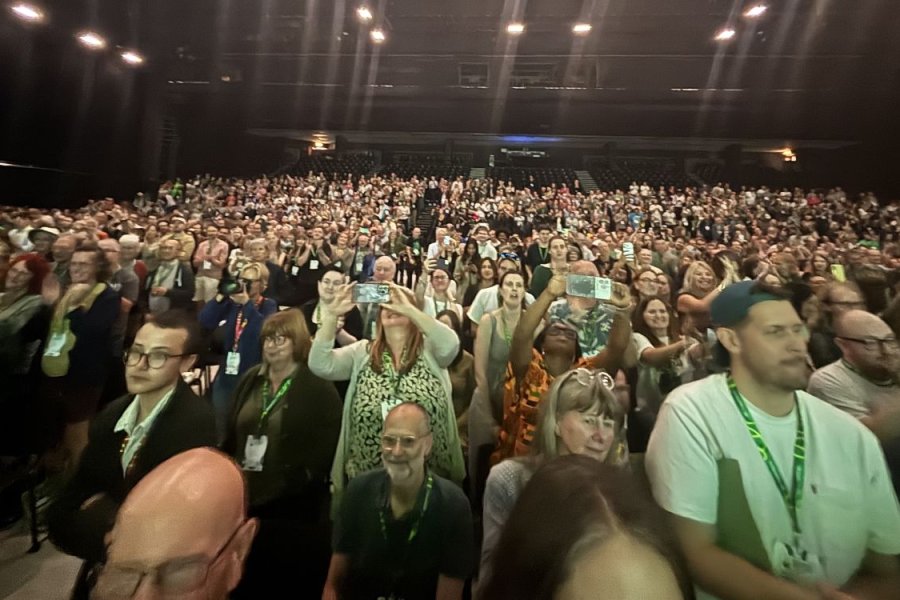
Muddled plenaries and a guessing-game agenda left members at this autumn’s conference all but shut out of policymaking. Liam Jones sets out how the party can give every member a real voice.
Like many people, I arrived at the Green party 2026 autumn conference full of optimism, excitement and a renewed sense of what was possible. And like many people, I was dismayed by what I experienced at the plenaries – the confusion, the disorganisation, the lack of information and, ultimately, the sense of having been almost disenfranchised by muddled proceduralism.
Don’t get me wrong. Most of my conference experience was positive. Nor do I wish to criticise any specific target. The standing orders committee (SOC) were doing the best they could with an unmanageable workload. The chairs, too, handled the plenaries better than I could. The attendees were passionate but respectful, even during the most divisive and emotionally challenging motion on Zionism is racism.
What let us down was not the people, but the institutional structures and processes.
More than one policy motion passed noted that the original Green party policies in that area were decades old and out of date. I believe the same is true of the party’s policy creation process. What may have been suitable for a small party of dedicated activists with no MPs doesn’t work for a large party with broad progressive appeal and a real shot at electoral power.
So, we desperately need to improve our policy creation process so all members can have a voice.
The problems
The most obvious issue on the plenary floor was confusion and disorganisation. Some of that was due to first-time attendees being unfamiliar with the many acronyms and jargon used by experienced members. But the problems ran deeper than that.
Which motions were we going to vote on in each session? The agenda was no guide. We had no idea until we attended the session and were told by the chair, upon which there was a frantic flipping through printed booklets or scrolling through PDF documents. A bundle of motions being fast-tracked at the start made the agenda even less relevant as a guide.
Because the agenda was so long, with many motions, the majority of which ran to several pages, it was all but impossible for many attendees to have familiarised themselves with the entire document beforehand. But since we didn’t know which motions would be brought until the start of the plenary session, there was little opportunity to read those motions until we were on the plenary floor. And by that point, there simply wasn’t time for attendees to properly read and think about the motion.
At one point, an inclusion card was raised about a speech that was mistaken about the content of an amendment. The chair declared this wasn’t an inclusion issue. I disagree. For those of us who are neurodivergent, clarity really is key to whether we can engage or not. This sort of confusion in particular could lead to people voting for a position they oppose.
The second most prominent issue to my mind was the lack of true deliberation. Debate in the plenaries consisted of no more than a series of for and against speeches (usually less than three rounds) for each motion and amendment. Requests for information or clarification were not allowed, which contributed to the confusion. The consequence was that the majority of attendees were unable to contribute in any substantive way.
Attendees who submitted speaker slips were given preference in speaking. This by itself is quite reasonable. But since it wasn’t clear ahead of time which motions would be debated, filling in a speaker slip may well have been a futile gesture.
Diagnosing the problems
At the root of all these problems, I believe there are three deep issues:
1. The conflict between participation and deliberation
There’s an issue that plagues all forms of democracy. The more people that are present in the room, the less opportunity there is for each person to speak in a debate. The plenary sessions offered the worst of both worlds. So many members attended that the debates had to be reduced to a handful of quick speeches, but conference attendees made up a tiny fraction of the membership.
2. A lack of adequate communication and information provided to members
If information about changes to the agenda had been provided sooner, so we knew before each plenary which motions we were going to discuss in that session, the sessions would have been much less confusing. Similarly, if we’d had more information about the motions themselves, if questions had been allowed on the plenary floor, it would have been easier for members to understand motions.
3. A lack of administration bandwidth
There was obvious tension around how the policy development committee had handled the policy submission process and how the SOC handled the plenaries themselves. But SOC is only a handful of volunteers, inundated with more motions than could be reasonably handled in conference. What we’re seeing here is administrative structures designed for a much smaller, slower party becoming overwhelmed by the requirements of the modern Green party.
Proposals and partial solutions
I won’t pretend that what follows is anywhere near a complete solution. It’s an opening gambit, to be expanded upon, critiqued, and improved. With that caveat out of the way, I suggest the following:
1. Massively increase the role of policy workshops before and during conference
Policy workshops are the stage between working groups and plenaries in the policy-making process, allowing members outside the working group to deliberate on, comment and critique a motion.
But the role of workshops is currently tiny. I think they can do much more. They’re small enough to allow genuine deliberation between members who are interested in a particular policy area, while opening up the discussion beyond a particular working group. We should give them more time, power, and ability to communicate. Specifically:
i. Workshops should come in two levels that each motion should pass through. The first level would be online, held before conference, and open to all members. The second would be in-person and held on the first day of conference. In fact, the first day of conference should be devoted to in-person workshops in addition to an A-motion plenary.
ii. Workshops, rather than plenaries, should have the power to vote on amendments. This would save time in plenaries and allow more focused deliberation about the implications of amendments.
iii. Workshops should also have the power to recommend a motion be fast-tracked, with the final vote on whether to fast-track motions held in plenaries. This would save SOC some administrative burden, while also reducing the concern of it having too much control over conference.
iv. Workshops should provide comments and summaries of policy motions, which would be read out in plenary before the motion and provided as text alongside the text of the motion.
This is how we can increase both deliberation and participation. There are too many motions for any one member to become acquainted with all of them. Instead, members can focus on the motions they find most interesting and get more deeply involved in debates. It also helps reduce issues of confusion in plenaries, both because of the summaries of motions provided by workshops and because many attendees on the plenary floor would have already gone through some motions in workshops.
2. Allow requests for information and clarification in plenary debates
The role of plenaries is to provide a final seal of approval of a motion, to pass it or reject it. If they’re to fulfil this role properly, it’s essential that members understand the motion and are clear about what it entails.
3. A dynamic agenda document that can be updated over the course of conference
If changes are going to be made to the agenda during conference, we need an agenda that can be updated as these decisions are made. This would have to be done online and require an extra layer of technology with permissions about who could edit it, which is a downside.
Conclusion
Right now, the fallout from the Zionism is racism motion and the Holborn and St Pancras by-election are sucking up all the oxygen in the room. Burnham’s rise to prime-minister has undermined the Green party’s momentum. Worrying about party processes might seem trivial by comparison. But headline news passes by quickly and the Green party will still be crucial in either pushing Burnham to the left, or taking up the progressive mantle if he fails. Either way, the party will remain a powerful electoral force. Improving party processes is unsexy but essential work, with effects that will remain as party leaders and prime ministers change.
Seeing problems and coming up with ideas is the easy part. The challenge will be in getting changes enacted. So, we need a Green party working group for the policy creation process itself, to refine and improve these solutions – or offer better ones – and to consider other problems that I haven’t mentioned here. And then to bring those solutions to conference and get them passed.
So, if what I’ve said here resonates with you, or if you’re aware of other efforts along the same lines, please do reach out. Let’s work together to get this done.
Left Field · Contributor
Liam Jones

Liam Jones is a writer, former carer, socialist and member of the Green party.
Popular This Week

More to explore

Tell Google you want to see more from us - set Left Field as a preferred source in your search results.

