Why the Green left keeps repeating Labour’s mistakes
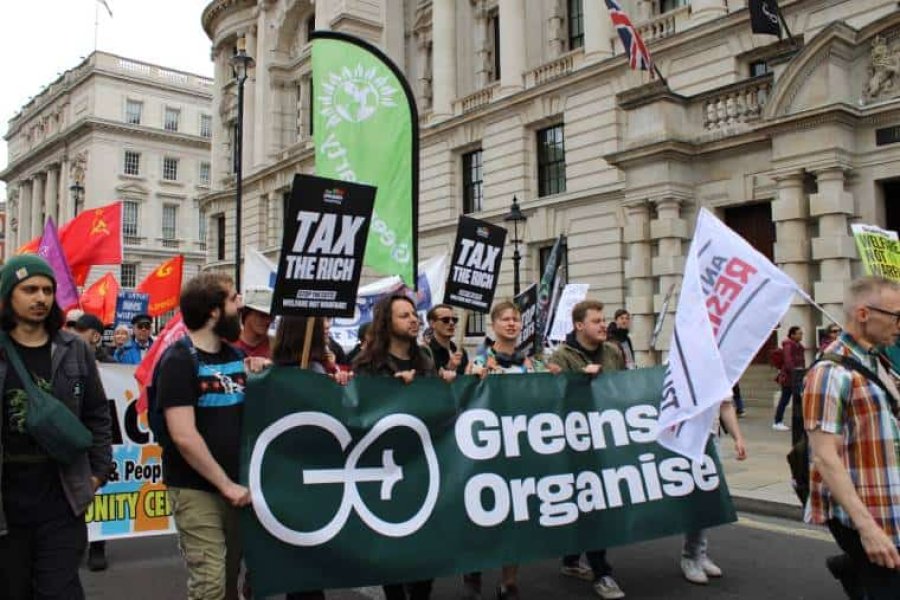
The Greens have inherited the space Corbynism left behind. They’re at risk of inheriting its central failure too, says Andrew Hedges.
In Russell Warfield’s new book, The Green Socialist: Zack Polanski and the Battle for Britain’s Future, he presents us with a narrative that places the Greens as both the predecessor and the heir of Corbynism. The anti-austerity politics the Greens built between 2010 and 2015, he argues, helped clear the ground Corbyn later stood on. Since Corbyn’s defeat in 2019, the Greens have become the natural home for what’s left of that movement. Zack Polanski’s rise looked, to many on the left, like proof the story was working. This week’s by-election defeat in Holborn and St Pancras, and the Greens’ slide in the polls since Andy Burnham took over, show that history does not move in one clear direction but is a series of uneven and complex movements.
Warfield’s is a flattering account. It’s also the wrong lesson to draw from what actually went wrong last time.
Corbynism’s defeat is usually explained through pinning blame on its opponents – a hostile press and a sabotaging parliamentary party. All of that is true enough as far as it goes. But it understates a failure that had nothing to do with any of Corbyn’s enemies. The project never did the patient, unglamorous work of turning outrage into organised power. It offered people a moral position – on austerity, on inequality, on foreign policy – without much of a route from holding that position to changing anything. More than six years on from Corbyn’s departure as leader, Labour’s own internal structures look almost exactly as they did before he arrived. That’s not solely his failing, but it is a verdict on the project.
The Greens are at real risk of repeating it, structure and all.
A politics of joining, not doing
Polanski’s appeal runs on the same logic Corbyn’s did. If you’re outraged about inequality, disgusted by pollution, angry about Gaza, there is a party for you to join. That’s not nothing – mass membership matters, and a left party that can attract people who’ve never been in a political organisation before is doing something right. But joining is not, by itself, a strategy.
The harder and more urgent question is what members are asked to do once they’re in the room. On that question, the Green left’s instincts look uncomfortably close to Labour’s under Corbyn: platform the position, rally the moral case and leave the actual mechanics of power – trade unions, industrial action, workplace organising – to whoever happens to be doing it already.


Russell Warfield’s book on the party captures this tension without quite naming it. At one point Warfield writes that the party’s animating purpose “will always be to form the first ever Green government”. Elsewhere, he floats a very different, movement-building vision of the party, one that might “escape the oscillation between movement building and electoralism” – without ever settling which of the two he actually thinks the party should be.
That’s not really a criticism of Warfield alone, it’s the same unresolved question sitting at the heart of Green politics more broadly and one the party’s leadership shows little sign of wanting to answer either. Nor does it look fully in control of its own agenda. At this month’s Brighton conference, members passed a motion declaring Zionism a form of racism by 1,022 votes to 813, while Polanski was away campaigning in Holborn. Four of the party’s five MPs publicly rejected it.
The gradualism problem
There’s an older version of this tension too – and it should sound familiar to anyone who’s spent time around the Labour left. Warfield describes ecosocialism as something reached by “strengthening social democratic principles which tend towards the eventual ability to transcend capitalism entirely” – a formula that could have been lifted from any point in the last 100 years of Labour gradualism. It’s compatible, on paper, with wanting to displace the profit motive from the economy. But it sits badly with a politics that recognises that the climate crisis is not something in the distant future but something we are living in today.
In practice, gradualism is the same story – change arrives eventually, by steady accumulation, without anyone having to make hard choices about where power actually sits in the meantime. The early Labour party believed something very like this. It’s one of the reasons the party spent so much of the 20th century managing capitalism rather than replacing it.
What the alternative looks like
None of this is an argument against the Green party, or against people putting energy into it. It’s an argument about where that energy goes. Corbyn had an opportunity to help reconstitute the working class as an organised political force – to recruit into trade unions, to back rank-and-file industrial action rather than simply repeating the positions handed down by union leaderships. That opportunity wasn’t taken, and its absence is a large part of why so little survived his leadership once it ended. Polanski has the same opportunity now, arguably a better one, given how much industrial action is already live. Disputes such as ongoing localised industrial action against cuts in the university, museums and health sectors and simmering unrest on the railways over working conditions aren’t short of energy, only of a political party willing to throw its weight behind them rather than issue supportive statements from the sidelines.
Warfield has a ready answer to all this. Writing in openDemocracy this week, he argued that pressure from Polanski’s Greens is what created prime minister Burnham in the first place. Polanski makes the same case, that the Greens can move Labour in the right direction. There’s something in that. But pushing Labour from the outside is still the politics of positions rather than power. The gains belong to Burnham, and what a Labour leader gives, a Labour leader can take away.
If the Green left wants to be more than the next moral holding-pen for people the Labour party has disappointed, that’s the test. Not whether it can recruit angry, well-meaning people who feel let down by Westminster – Corbyn proved that’s the easy part – but whether it can turn that anger into the kind of organised, workplace-rooted power that outlasts a single leader’s popularity.
On the evidence of Warfield’s book, and of the party’s own internal culture, nobody currently running the Green party has decided that’s the job they need to take on.
Andrew Hedges is a member of the Green party.
Left Field · Contributor
Andrew Hedges

Popular This Week

More to explore



Tell Google you want to see more from us - set Left Field as a preferred source in your search results.

