Greens pass “Zionism is racism” motion as amendments fall
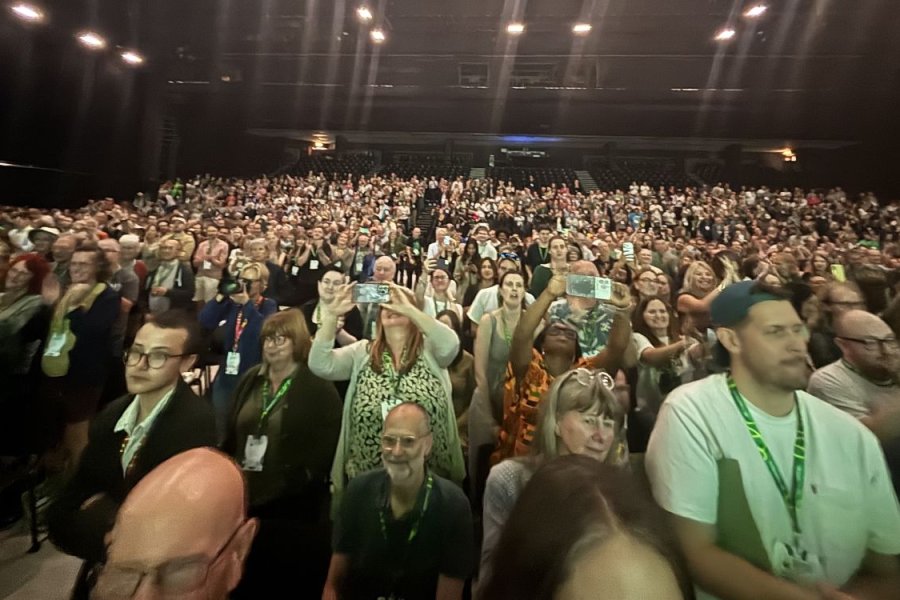
Green party members voted by 1,022 to 813 to declare Zionism a form of racism and back a single democratic state, rejecting three amendments that would have softened the motion.
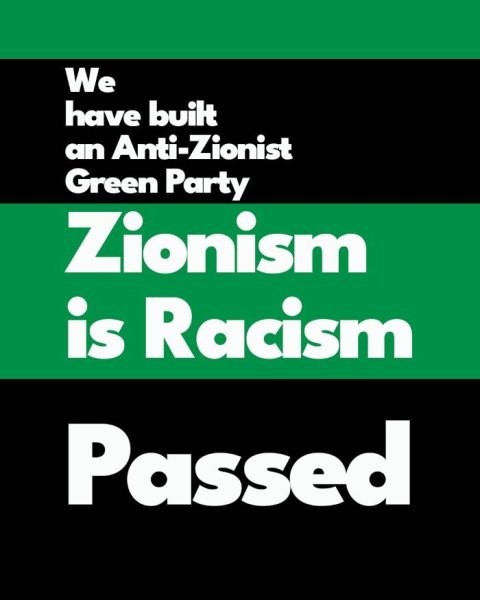
Green Party members have voted to declare that Zionism is racism, passing the motion by 1,022 votes to 813 on a card vote at the party’s autumn conference in Brighton on Sunday.
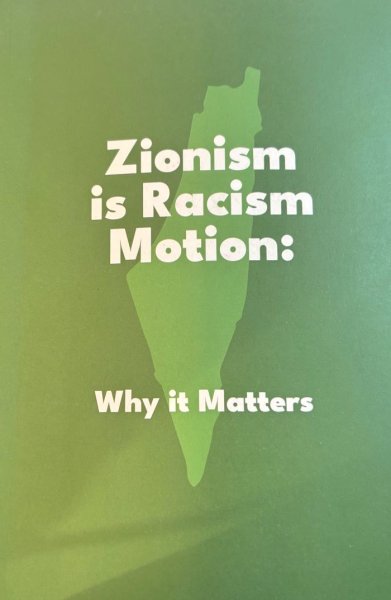
The motion, tabled by the campaign group Greens for Palestine, commits the party to “a single democratic Palestinian State in all of historic Palestine with Jerusalem as its capital”, with equal rights for all and the right of return for Palestinians and their descendants. It states that Zionism “will be treated as any other form of racism”.
Members rejected three amendments that would have softened it. One would have barred the motion from being used to discipline members over their links to Jewish community institutions that describe themselves as Zionist. It fell by 1,026 votes to 684.
The Movement for Progressive Judaism condemned the result, saying the party had “made antisemitism party policy”. A Green Party spokesperson said conference had made its decision and that the party remained “an anti-racist party”.
Within hours, the party’s leadership issued a joint statement saying the Greens “will never tolerate any form of discrimination or harassment” and that “there is no conflict between supporting the rights of Palestinians and the rights of Jewish people”. It did not mention the motion or Zionism.
The vote is understood to make the Greens the first major UK party to formally adopt an anti-Zionist position. It comes four days before the Holborn and St Pancras by-election, in which party leader Zack Polanski is the Green candidate.
Safeguard rejected
Amendment 3 would have added a clause stating that the motion “shall not be used to pressure, proscribe or discipline members based on affiliation with Jewish community institutions, such as synagogues, community centres or denominational groups, that describe themselves as Zionist”.
It would also have barred the party from sanctioning Jewish members for views that would not be sanctionable if expressed by non-Jewish members, “such as support for a binational state, or two state solution”.
After a close show of hands, the amendment went to a card vote and was lost. Its defeat means the adopted motion contains no such safeguard.
Supporters of the motion argued the amendment was unnecessary. They said the motion already separates Judaism from Zionism, and that it will have no disciplinary impact because it is a political policy motion, not a change to internal party procedures. Critics point to the motion’s own action points, which state that Zionism “will be treated as any other form of racism”. How the party applies that clause will now come under close scrutiny.
Self-determination amendments fall
Two further amendments sought to replace the commitment to a single state. They would have left the constitutional outcome to Palestinians themselves.
Amendment 1 would have backed “a reparative, democratic and just process” towards a lasting settlement, its form “shaped and determined by Palestinians themselves however they see fit”. It was lost on a show of hands and then on a card vote, by 920 votes to 821.
Amendment 2 would have said the Palestinian people “must be free to decide the constitutional form of that solution (for example one democratic state, two states or a confederal arrangement)”. It was also defeated.
Supporters of the amendments argued that it was for Palestinians to determine their own future, not for the Green Party to stipulate it. One speaker against them made a forceful case for a single state.
A fourth amendment, accepted by the movers, was passed. It deletes sections IP600 to IP613 and IP622 of the party’s international policy so that it is consistent with the single-state commitment.
The debate
Moving the motion, Lubna Speitan said: “Zionism is not an academic issue. It’s reality. This motion is not about imposing a solution. We want the return of land that was taken from us. Vote for a free Palestine from the river to the sea.”
She focused on the argument that Zionism, as a settler-colonial project, was racist, rather than on the criticisms raised in the run-up to conference. In her right of reply, she said that by passing the motion the party would be rejecting racism in all its forms and taking a principled stance.
Stephen Kapos, a Holocaust survivor from Camden, spoke in favour. “Zionism is an extreme form of racism. Fifteen members of my family perished in the gas chambers,” he said. “It has soon become clear that Israel is a Zionist apartheid regime. Zionism and genocide have become intertwined.”
Deputy leader Mothin Ali also backed the motion. “This is a difficult subject. It took me a while to decide whether to speak. Given that some high-profile people have spoken it is my duty to do so,” he said. Another speaker described the motion as well thought out and Palestinian-led.
Ellie Chowns MP spoke against. “If this motion passes it will hugely reduce our effectiveness and will see the Greens portrayed as an antisemitic party,” she said.
Former leader Caroline Lucas urged members to reject it. “I’m long committed to the Palestinian cause. We need to understand what Zionism means. Zionism was historically a response to racism for many,” she said. “I urge you not to support the oversimplification of the issues contained in this motion. Don’t alienate Jewish people by passing this motion.”
A member from Birmingham Green Party argued that the party had already won the public argument on Palestine. “Outside of this room Zionism is not clearly understood. But we have won the argument on Palestine and the genocide. Make use of the fact that the majority of people are on our side,” he said. He warned against alienating potential supporters and handing the media a gift.
Despite the strength of feeling, the debate was conducted respectfully throughout.
Greens for Palestine
MPs split from members
Two other Green MPs had set out their opposition before the debate. Adrian Ramsay, MP for Waveney Valley, said he would vote against, arguing the motion “will be widely viewed as going against” the party’s long-held support for equal rights and self-determination for Palestinians and Israelis.
Carla Denyer, MP for Bristol Central, said in a statement that she “cannot support it as it has been written”. She warned that the wording “risks alienating a significant proportion of Jewish people”, including many who support boycott, divestment and sanctions.
Polanski did not vote. A party spokesperson confirmed he was campaigning in Holborn and St Pancras while the vote took place, and that he did not vote in person or online. Before conference he had called the motion an “unhelpful distraction” and said he wanted to see it amended. Asked by the BBC on Saturday whether he believed Zionism was racist, he said: “Well, in the motion, it is defined as the displacement and genocide of the Palestinian people. I think that is clearly racism.” He has also stressed that policy is decided by members on the conference floor.
What else the motion says
The motion also affirms the Palestinian right “to resistance and liberation from Israeli occupation, domination and subjugation”. It describes the struggle for that liberation “by all available means under international law” as legitimate.
It backs broad boycotts and divestment against Israel, calls on the UK government to impose full embargoes and sanctions, and calls for the release of Palestinian prisoners of conscience, including Marwan Barghouti. It also calls for Palestine Action to be removed from the list of proscribed organisations, and for the release of prisoners held for non-violent direct action in support of Palestinian rights.
Reaction
Rabbi Charley Baginsky and Rabbi Josh Levy, co-leads of the Movement for Progressive Judaism, said: “The motion is antisemitic in its formulation and intention. By adopting it, the Green Party has made antisemitism party policy and become a racist party.”
A Green Party spokesperson said: “This has been a serious and deeply felt debate within our membership. Our members value the ability to bring forward and decide party policy, and conference has now made its decision.”
“The Green Party is an anti-racist party and has consistently opposed the illegal occupation of both Palestinian and Syrian land, called for an end to arms sales to the Israeli government and spoken out fearlessly about the devastating situation in Gaza and the West Bank.”
“Those positions remain central to our approach. So too does our deeply held commitment to equality, justice and human rights for all and opposition to racism in all its forms.”
The joint statement from the leadership was signed by Polanski, deputy leaders Rachel Millward and Mothin Ali, and all five Green MPs: Siân Berry, Ellie Chowns, Carla Denyer, Adrian Ramsay and Hannah Spencer. The signatories include Ali, who spoke for the motion and Chowns, Denyer and Ramsay, who opposed it.
“As Greens, we will always uphold universal human rights. We will never tolerate any form of discrimination or harassment,” it said. “We will continue to stand in opposition to genocide, ethnic cleansing, apartheid and the illegal occupation. We will continue to call out the heinous crimes of the Netanyahu government.”
“And we will continue to work to ensure that the Green Party is an anti-racist party in every way. We know there is no conflict between supporting the rights of Palestinians and the rights of Jewish people.”
Richard Sanders of Double Down News welcomed the result, while acknowledging the backlash it would bring. “Given the ferocity of the backlash it will provoke I’m sympathetic to anti-Zionist Greens who feel that, tactically, they could have done without it at this time,” he said.
“The problem is Zionism is racism … Zionists’ key weapon is their ability to obfuscate and complicate. This cuts through that and provides the moral clarity they dread. We live in a time of genocide. If not now, when?”
The motion topped the members’ ballot used to prioritise conference business. It was due to be heard at the spring conference in March but ran out of time after a series of no-confidence motions in the chair took up the agenda.
Left Field · Contributor
Left Field reporters

Left Field's collective of writers have contributed to this article.
Popular This Week


More to explore



Tell Google you want to see more from us - set Left Field as a preferred source in your search results.

