Is the Green party really Britain’s most democratic party?
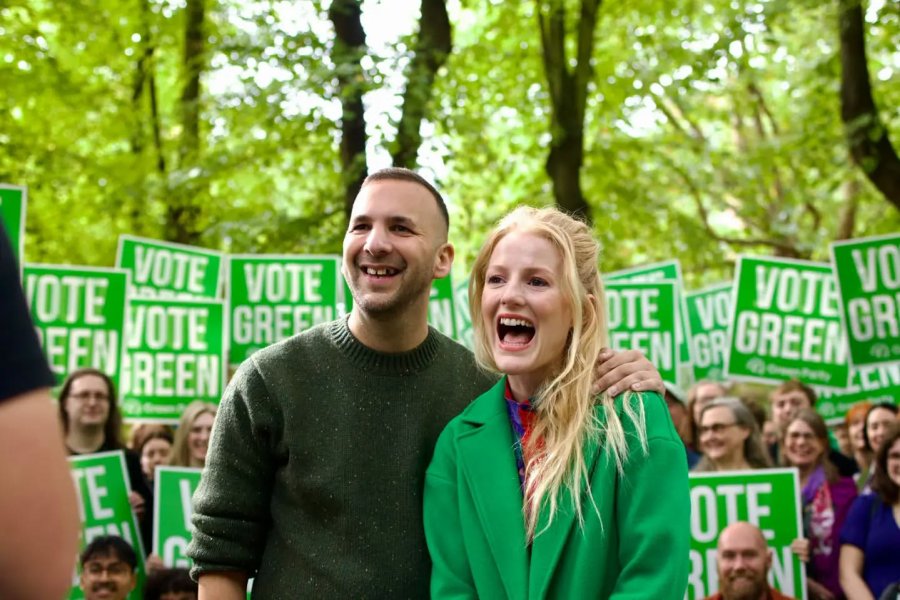
Green party leader Zack Polanski and Hanna Spencer MP pictured during campaigning in Holborn and St Pancras. (Photo: London Green party Facebook)
The Greens like to present themselves as more democratic than their rivals. Look past conference and the picture is far messier, says Andrew Hedges.
It has become a settled piece of political common sense that the Green party is more democratic than its rivals. The party’s own members say it. Sympathetic commentators say it. Even critics tend to concede the point before moving on to something else. The case usually rests on one claim: Green party conference sets party policy directly, rather than leaving it to a leadership or a policy forum.
That much is true. It’s also true of Labour conference, which likewise has formal sovereignty over party policy – and which likewise has no mechanism to make MPs vote accordingly. If anything, Labour members have a clearer read on where their parliamentary party actually stands – the whip’s position is public and immediate. In the Greens, with no whipping system, working out the party’s position on a given issue can mean checking the voting records of five different MPs and hoping they agree.
That’s not a minor technicality. It goes to what “democratic” is supposed to mean in practice, once you get past the conference floor.
No constitution, no consistency
Let’s start with the basics. There is no standardised constitution for local parties and no standardised selection process for choosing council or parliamentary candidates. What exists instead is a patchwork of local custom and practice, evolved independently over decades, that makes the party close to impossible to describe in the abstract. Rule books exist, but whether any given local party follows them is another matter.
Decentralisation is often cited by the party’s own supporters as one of its more attractive features – a rejection of the centralised, top-down model associated with Labour and the Conservatives. There’s a case for that. But decentralisation without consistent structure has a cost too – it makes the party hard to hold to account for anything, including its own stated programme. A national platform is only as good as the local parties’ willingness, or ability, to act on it.
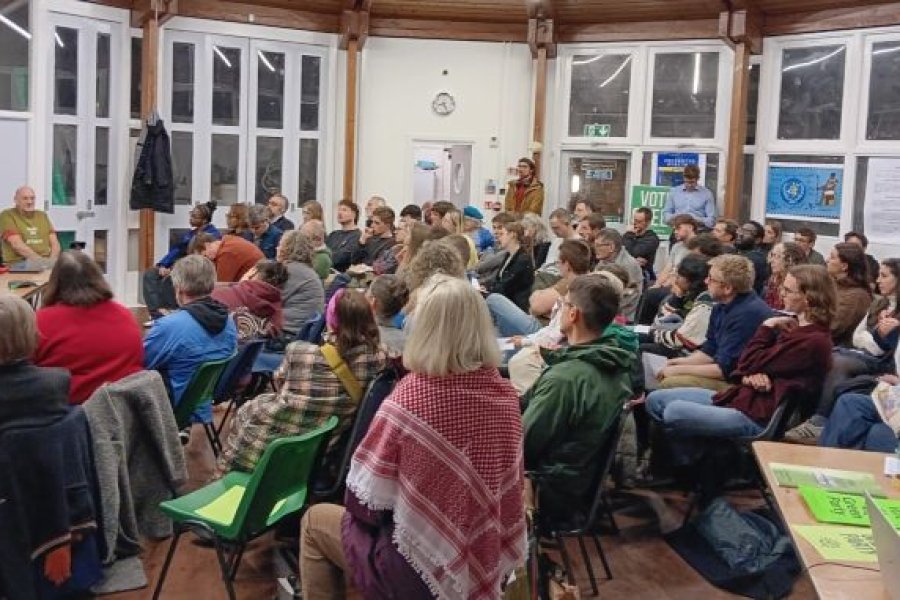
In practice, local Green meetings often don’t function like conventional party branch meetings. Motions and votes are the exception rather than the rule. The preferred method – consensus decision-making – is presented as a more inclusive alternative to the win/lose mechanics of a vote. In practice it frequently produces long, meandering discussions that end without a clear outcome, leaving decisions to fall by default to unelected working groups, generally staffed by whoever has the time to attend endlessly.
That’s not a small point about meeting culture. It means real decision-making power tends to accrue to people with the flexibility to do a lot of unpaid, informal organising – which in practice tracks fairly closely with class and job type. It also explains an odd structural mismatch at the heart of the party, where we have a national organisation professional enough to be run by a chief executive, sitting above local parties that often don’t even have a formally elected chair or secretary, preferring looser titles like “facilitator”.
Open selection, with limits
The party’s defenders are right to credit it with open selection – prospective parliamentary candidates must win the explicit support of their local party against rival candidates, rather than being imposed from the centre. It’s a genuinely democratic feature and one Labour members would recognise the value of. But it comes with a catch that rarely gets mentioned alongside it. And that is that candidates are usually barred from running anything resembling a substantive political campaign against one another during selection. This empties out much of the point of having a contest at all. A selection process that can’t feature real political campaigns by candidates is a fairly thin version of democracy, whatever else it gets right.
Who gets to turn up
The same pattern shows up in how the party treats attendance at its own supreme decision-making body. National conference is open to any member who can afford to attend, with a limited hardship fund available for those who can’t. Labour, by contrast, operates on a delegate model where local parties elect delegates, who are then supported with accommodation, travel and conference passes as a matter of course, because Labour’s structures assume that representation should not depend on personal means.
The Greens means-test that support instead. The practical effect is a conference whose composition skews toward members with the time and money to attend, on issues ranging from national strategy to conference motions on subjects as narrow as regulating the decibel level of fireworks – the kind of thing that tends to make it onto the agenda when the barrier to raising an issue is simply showing up and wanting to be heard, rather than winning the backing of an elected delegation first.
A democratic label doing a lot of work
None of this is to say the Green party is uniquely undemocratic, or that Labour’s own internal life is a model worth envying. But the claim that the Greens are simply the more democratic party doesn’t survive close contact with how the party actually runs itself, below the level of conference. A serious reckoning with that structure – not just the branding – matters more, not less, the closer the party gets to real power.
Left Field · Contributor
Andrew Hedges

Popular This Week



More to explore



Tell Google you want to see more from us - set Left Field as a preferred source in your search results.

