“Nobody is coming to save us”: Greens’ left asks what it takes to build an ecosocialist party
By Andy Walker
Left Field
The Life of the Party podcast brought its live show to Brighton, pitting ecosocialism against ecopopulism and urging Green members to organise, stand and argue.
“Nobody is coming to save us. Embrace it.” That was Joe Todd’s challenge to Green members in Brighton as the Life of the Party podcast asked what it would take to build an ecosocialist Green Party.
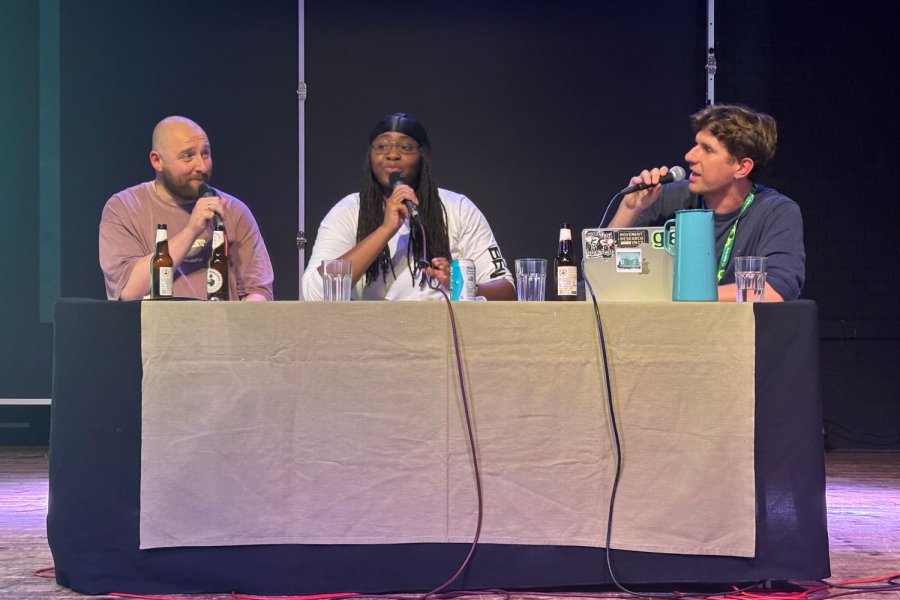
The live recording, hosted by Greens Organise and Brighton and Hove Green Party, brought the podcast’s regular presenters – Joe Todd, Shanice McBean and Jonas Marvin – to the Green conference on Friday evening.
Life of the Party, produced by Ampersounds Productions, launched in September 2025 to track the debates, personalities and strategies reshaping the British left. “We set up the podcast in the early days of enthusiasm of the formation of Your Party,” McBean said.
Verdict on the leader
The panel opened with Zack Polanski’s conference speech earlier in the day. Marvin said that he had always been candid about the state of the party. He welcomed Polanski talking more about community, about making life more affordable, about “an internationalist approach to planetary politics” and about “the caring majority”.
Todd was struck by the conference itself. “Good to be part of a conference that was professionally run. It feels like a party that can run the state,” he said. “There was a real energy from Zack.”
Ecosocialism or ecopopulism?
McBean put the central question bluntly. “The Greens have never positioned themselves as a socialist organisation, as ecosocialists,” she said. Todd, speaking about the role of Greens Organise, the party’s organised left network, said the label was easy to claim. “Everyone now identifies as an ecosocialist because it’s fashionable, but how do we get there?”
He framed the choice as “ecosocialism versus progressive environmentalism and ecopopulism”. The latter two, he argued, were not about transforming society and moving beyond capitalism. Ecopopulism, he said, was “the fast-food version of ecosocialism”.
McBean was more cautious. Ecopopulism was attractive and moved people, she said, while ecosocialism was a slower burn that offered less immediate gratification. People were drawn to what “feels good” over the long-term work, so ecosocialists had to win the argument ideologically.
She also argued that the left’s historic defeats had left many people believing they could not change the world. Todd called that overly pessimistic. People were getting organised, he said, pointing to the growth of renters’ unions.


Leadership, organisation, programme, roots
Todd said the foundations for ecosocialism already existed in the Green party. Building on them meant focusing on four things – leadership, organisation, programme and rootedness.
That meant more members standing for public office and for party positions. “It’s essential that people stand for positions in the party – because that’s how you can influence and change things,” he said. “What does it mean for us to step up into a leadership role?”
Rootedness, he said, meant the Greens being embedded in communities beyond election time. Capacity and money had to go into building Green branches everywhere.
He also called for more open argument. “People are always trying to seek consensus but that’s not always a good thing. We need to learn to disagree in a comradely way,” he said. “Ecosocialists have a clear critique of the state. We need to debate these issues in the Green Party.” The party also needed its own think tanks, he added.
Hyperpolitics and the Burnham test
Marvin pointed to La France Insoumise and the current wave of student protests in France as examples of ecopopulism and ecosocialism being blended in practice. But he warned that the left was living through a complex and contradictory period. He cited the historian Anton Jäger’s idea of “hyperpolitics” – an era of intense political engagement and viral outrage that rarely produces lasting structural change.
On Andy Burnham, Marvin said the left had to recognise that the prime minister’s conference speech would have moved some people. But if Burnham fails, he warned, it will strengthen the belief that things will never change.
For anyone serious about organising, Marvin recommended Our Flag Stays Red by Phil Piratin, the Communist MP for Mile End from 1945 to 1950. The book recounts communist and anti-fascist organising in London’s East End in the 1930s and 1940s.
Alive and kicking
It was refreshing to hear a podcast getting into the detail and doing it in a lively way – complete with book recommendations and documentary plugs. Not nearly enough political media does this. Questions from the floor were sharp, and the room had a real thirst for ideas, sparking further debate among the presenters. The panel did not shy away from the difficult questions either.
If anyone doubted that the tradition of socialist discussion and debate is alive in the Green Party, this event put that to rest.
Life of the Party is available on Spotify and other podcasting platforms.
Left Field · Contributor
Andy Walker

Andy Walker is the founder and editorial director of Left Field. He is a journalist and the secretary of the Newcastle branch of the National Union of Journalists.
Popular This Week


More to explore



Tell Google you want to see more from us - set Left Field as a preferred source in your search results.

