Burnham’s national care service is the right idea, so why wait?
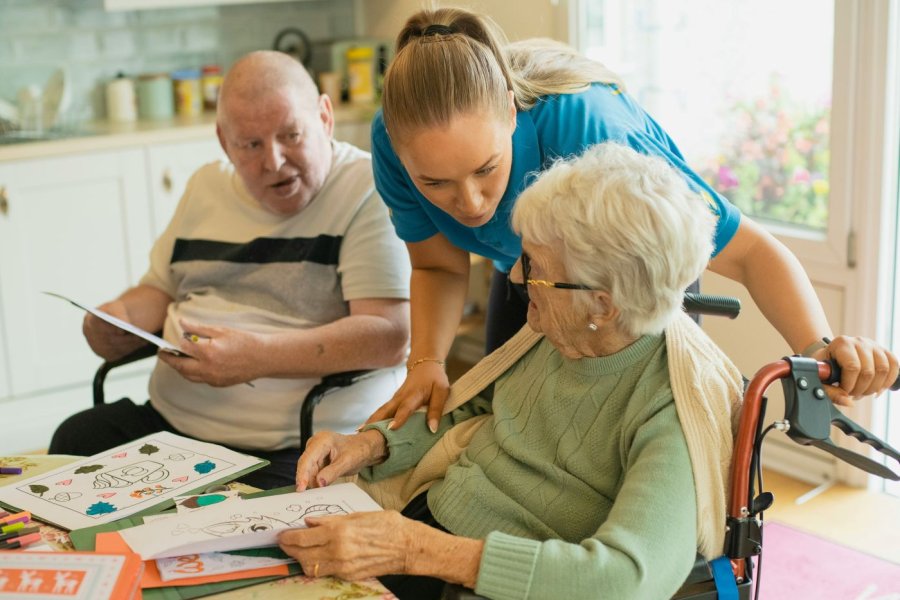
A care worker in Wales helping residents with social activities. (Photo Age Cymru on Unsplash)
Daniel Emmett-Gulliver is no fan of the prime minister. But he says a national care service could be the NHS of our time, if Burnham has the courage to deliver it.
My phone pinged. “Breaking News: Andy Burnham proposes national care service to tackle ‘threadbare’ social care system.” My immediate reaction was telling. I said, simply: “Wow!”
I had felt that Burnham shouldn’t be in the position he is in, or in the way that he has come to be in it. Watching him outside Downing Street on 20 July 2026, I thought he talked a good talk but would fail to walk the good walk. Why should he be any different to the prime minister he had dethroned?
Westminster, SW1, parliament, or however you refer to it, seems not just to be full of politicians looking to climb the greasiest of poles, but stuck in a moment it can’t get out of. I feel like I have ended up among a sizeable sample of the wider public who say: “He's just the same as all the others.”
I don’t disagree. I haven’t had a Damascene conversion. There is much of Labour’s agenda, particularly its economic agenda, that I viscerally disagree with. But I digress – play the ball, not the person.
A national care service is an idea whose time has come. When the National Health Service was born out of an idea from the South Wales valleys in the aftermath of the devastation and destruction of the second world war, Britain’s population was starting to boom. It is no longer booming, and it is conceivable that octogenarians will outnumber eight-year-olds within my lifetime. According to the Office for National Statistics, the number of people aged 85 and above will double from 1.8m in 2024 to 3.6m by 2049.
This won’t just put an incredible strain on our already strained NHS, but also on the less-than-ideal care infrastructure that we currently have in place.
I am 100% signed up to the principle of a national care service. They say necessity is the mother of invention, and we have to fix the broken care system in the UK urgently. It isn’t just financially broken, but also logistically and morally. If there were ever to be a British-style charter of rights and freedoms, then the right to a dignified old age should be right up there.
It also strikes me that the moral imperative for a care service, available to all at the point of delivery regardless of financial means, hasn’t been made as consistently and forcefully as it can and should be. Octogenarians can be some of the most vulnerable in society. It is unconscionable that private enterprise should profit from the plight of vulnerable individuals.
So, the principle is sound. But I am getting ahead of myself.
This isn’t a policy that is going to be introduced in this parliament. It is an aspiration. An intention. A plan. That raises questions of its own.
Why not introduce it in this parliament? We all know the problem. If this is this government’s solution, go with the courage of your convictions and introduce it. Sure, it wasn’t in Labour's Change manifesto of 2024, but the world of 2026 is radically different to that world.
If manifestos become straitjackets that are too rigid, they cease to be effective. Foreign policy shows that. The UK’s involvement in the first Gulf war was not in a manifesto. Neither was the retaliatory strike against Afghanistan, nor the second Gulf war. There has to be a certain amount of flexibility and agility in domestic policy as well.
Another immediate question is why the service will only cover England. England is not the United Kingdom, just as London isn’t England. Social care is devolved, so Westminster can’t simply impose a service on Wales, Scotland and Northern Ireland. Scotland shelved its own plans for a full national care service in 2025. But a truly national service would need all four nations on board and the government should be making that case to Cardiff, Edinburgh and Belfast now.
Another question requiring an immediate answer is how this proposal will feed into the Casey Commission. Is there ongoing work that is now obsolete if the government has explicitly stated the option it prefers? If so, it should be mothballed with immediate effect, its findings published as provisional and Baroness Casey, her colleagues and contributors to the commission thanked for their efforts.
The prime minister’s announcement also challenges the other parties to nail their colours to the mast on this issue. And what of Labour, which has largely backed Burnham's unconventional route to power? While his announcement seems a welcome departure from the consultations, promises of jam tomorrow and perpetual can-kicking, it still has a hint of all of those, given all these unanswered questions.
Burnham is a relatively unknown quantity and we keep being told that we will hear more about him at this and that time. The latest iteration of this is that he will reintroduce himself to the country when he delivers his leader’s speech at Labour's conference in Liverpool tomorrow. If he sticks to his guns on a national care service, it could be one of the fundamental pillars of his personal and political legacy.
But there is a good innovation and then a great innovation.
So, Andy? A national care service could not only solve the long-documented issues in non-NHS care provision in this country, it could also become a beacon of Britain at its best and a vocation that we could all get involved in.
Imagine the one million young people not in education, employment or training, and over-50s, contributing to this service. Or introducing a national care service visa to encourage the best and brightest from around the world to join this endeavour. Imagine corporate buy-in, with companies encouraging employees to use their volunteering days to support this service. Or encouraging corporates that do not already give their employees volunteering days to do so. Finally, imagine using a national care service dividend through the tax system to incentivise reluctant corporates.
Burnham’s announcement will come with an expensive price tag. But in terms of empathy, it is the NHS idea of the here and now. And the potential it provides to tackle systemic as well as socio-economic issues is really exciting.
I’ll whisper it softly, but maybe Andy Burnham isn’t just like all the others maybe he offers something genuinely different.
Left Field · Contributor
Daniel Emmett-Gulliver
Daniel Emmett-Gulliver is a native Londoner and adoptive Welshman, who is passionate about politics, fairness and equality.
Popular This Week



More to explore



Tell Google you want to see more from us - set Left Field as a preferred source in your search results.

