Glasgow band’s new song demands justice for Scotland’s first working-class martyrs
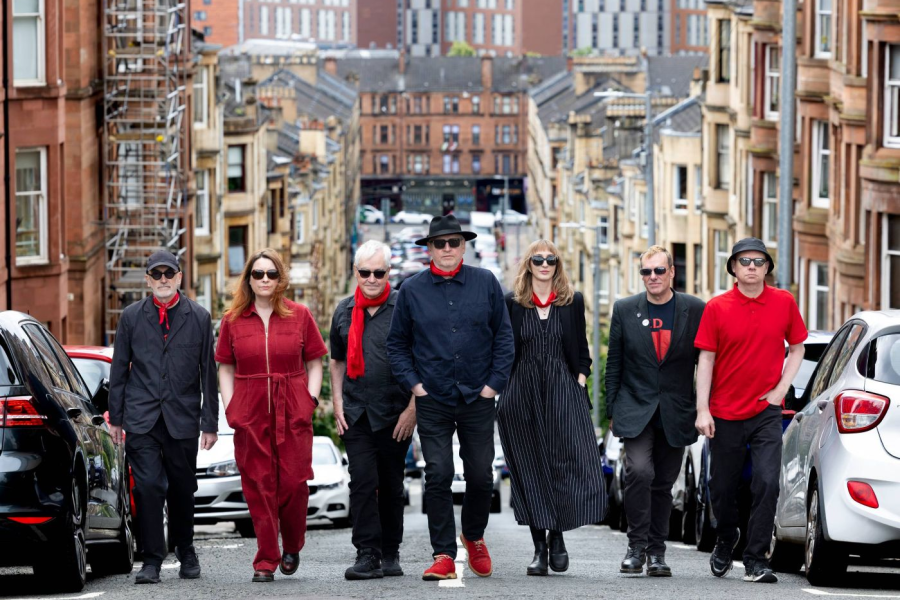
The Tenementals (L-R) Bob Anderson, Therese Martin, Mark Ferrari, David Archibald, Olivia McLean, Simon Whittle and Ronan Breslin. (Photo courtesy of Martin Shields)
The Tenementals’ new single tells the story of the Calton weavers, shot dead by troops in 1787. It backs a campaign to strip army officers of their civic honours and restore the weavers’ neglected graves.
The latest single from Glasgow band the Tenementals, a group of musicians and academics known for telling the radical history of Glasgow through song, shines a light on the hidden history of Scotland’s first working-class martyrs.
“The Broken Stones of The Calton Weavers”, released earlier this month, is the first single from their forthcoming second album. The song, which recalls the struggle and sacrifice of the Calton weavers, has been released to raise awareness of a neglected aspect of Scottish history.
The song takes its inspiration from the Calton weavers, hardworking cotton workers who were at the centre of Scotland’s earliest major industrial dispute. During a strike over wages and conditions on 3 September 1787, troops fired on demonstrators in the Calton area of Glasgow, killing six men. Three of the weavers are buried in the Calton burial ground with a campaign to restore the men’s memorials launched in 2023. The stones are in a chronic state of disrepair.
David Archibald, who founded and fronts the Tenementals, said: “The weavers were striking to protect their livelihoods when they were met by the full force of the British Army. To their eternal shame, in the aftermath of the event, the Glasgow authorities awarded the Freedom of the City to the army officers who ordered the killings.
“The event is important as in many ways it marks the beginnings of the organised labour movement in Scotland. Yet if you go down to the Calton burial ground, where three of the weavers are buried, the commemoration stones are in a sorry state. Their memory has been sorely neglected. At the same time as the weavers were being hidden from history, there were three statues erected to Tory MPs in Glasgow.
“As we say in the song, ‘Who is remembered? Who is forgotten?’ Glasgow likes to think of itself as a radical city and yet these men whose actions were key in forging the modern labour movement are largely ignored. The Calton Weavers Commemoration Committee has been doing great work to highlight awareness of the weavers’ story and we hope that our song can add weight to their campaign.
“The weavers suffered a terrible injustice in life and in death. It is time to commemorate the weavers in a manner which reflects the importance of this historical event. A small step would be for Glasgow City Council to rescind the Freedom of the City which was awarded to the killers and grant the retrospective Freedom of the City to the Calton weavers. It’s the least they can do.”
A petition has now been set up calling for the centuries-old injustice to be righted. It calls on Glasgow City Council to formally disassociate the modern City of Glasgow from the historic civic honours bestowed upon the military officers who ordered the 1787 massacre, revoke all civic honours granted to the officers and bestow the Freedom of the City to the weavers.
Sign the petition in support of the Calton weavers here.
Left Field · Contributor
Left Field staff writers

This article was written by a staff writer or a group of writers from Left Field.
Popular This Week



More to explore



Tell Google you want to see more from us - set Left Field as a preferred source in your search results.

