A permanent charter won’t save the BBC. Handing it to the public might
By Andy Walker
Wikimedia Commons / Alexander Svensson
As ministers prepare their BBC white paper, a new book argues that the corporation’s survival depends on turning it into a co-operative run by the people who fund it – an idea the Greens now back.
The government is expected to publish its white paper on the BBC’s future before the end of the year, setting out its policy decisions for the next royal charter. The current charter expires at the end of 2027.
The headline change is already known. Culture secretary Lisa Nandy has said the government will move to place the BBC on a permanent royal charter, ending the current system under which the corporation’s constitutional basis must be renewed periodically.
Speaking at the Society of Editors conference in London in March, Nandy said the change was intended to “future-proof” the BBC. “So, while the terms, the structures and the funding for the BBC will continue to be negotiated every several years, we should seek to end the bizarre situation where if the charter isn’t agreed in time, the BBC ceases to exist,” she said.
The BBC had argued that the ten-year renewal cycle creates instability and leaves it vulnerable to political pressure. In its response to the government’s consultation, it also called for an end to government appointments to its board.
Nandy has signalled she wants something in return: stronger accountability inside the BBC, with more commissioning power moving to the nations and regions and reforms to give staff a stronger voice in holding leadership to account.
Ministers keep their grip
But campaigners say a permanent charter changes less than it seems. The Media Reform Coalition argues it will not protect the BBC from political interference unless it is paired with an end to government powers over the charter, board appointments and funding. As Nandy’s own words make clear, ministers will still negotiate the BBC’s terms, structures and funding every few years.
Others want the permanent charter to come with deeper change. Granville Williams, of the media reform group the Campaign for Press and Broadcasting Freedom (North), said: “The BBC charter renewal takes place as the broadcaster finds itself in a dire predicament. As it struggles to make cuts, slashing jobs, services and programmes, a new report says the revenue from the licence fee is in a ‘spiral of decline’.
“Many of the problems the BBC now faces are due to political interference, which has seen licence fee revenue fall by nearly 40% since 2010. That’s why a future charter needs the BBC to be independent from, and protected against, political interference. We can ensure this by establishing the charter on a permanent basis and creating a new independent body to run the BBC which excludes government appointments.
“Crucially though, the licence fee needs to be replaced, and we think a household levy, with exemptions for poorer households, is the best alternative.”

OR Books
A co-operative BBC
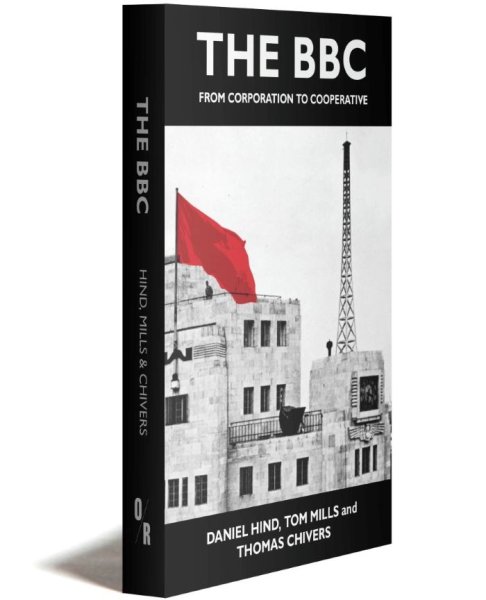
A new book due out in January goes much further. THE BBC: From Corporation to Cooperative by Daniel Hind, Tom Mills and Thomas Chivers puts forward a bold plan to save the BBC – by democratising it.
The book develops the authors’ 2025 report for the think tank Common Wealth, Our Mutual Friend: The BBC in the Digital Age, which set out how a mutualised BBC could work in practice.
For more than a century, the BBC has been at the heart of British culture and a model for public media around the world. But government encroachment, underfunding and digital competition have pushed the corporation into crisis.
The book argues that the BBC’s enemies on the right have spent years working towards its downfall. Meanwhile, many of its natural supporters have lost heart, dismayed by the corporation’s serial breaches of its own public-service principles. Having so often betrayed its friends to appease its foes, the authors say, the BBC now finds itself isolated and under attack.
Hind, Mills and Chivers warn that the BBC will not survive unless its popular legitimacy is renewed. The public, they argue, will only show up for a BBC remade into something worth defending: a democratic institution meaningfully accountable to the citizens who fund it.
An idea gaining ground
Campaign group the Media Reform Coalition has been arguing for ‘a People’s BBC’ for a number of years and issued its Manifesto for a People’s Media back in November 2021. Only this October, the Green party conference passed a landmark motion to shift media away from corporate control towards public participation, including mutualising the BBC.
Under the policy, the BBC would be mutualised – effectively becoming a co-operative – with its audience having a direct say in how the nation’s public broadcaster is run. Supporters say this would insulate it from both state and private interference.
The Greens’ policy platform treats culture, media and sport as essential public goods that contribute to democracy, wellbeing, social cohesion and sustainability. It lays out sweeping measures to improve cultural life, democratise powerful institutions and break the stranglehold of corporate power in media, technology and advertising.
Under the party’s plans, the BBC would remain a publicly funded public service broadcaster but controlled democratically by the public rather than by government. The licence fee would be replaced with direct public funding, citizens would be given a formal role in BBC governance, and the BBC would support local journalism and new public-service social media platforms.
The party says the changes would make the BBC more accountable, representative and participatory. Rachel Millward, deputy leader of the Green party, said: “This landmark motion puts forward bold and necessary steps to ensure the BBC remains what it is when it’s at its best. A strong, impartial, public service broadcaster free from private interest and shielded from the whims of politicians benefits us all.”
Nor is the model confined to the left. In its response to the government’s consultation, Co-operatives UK proposed keeping the BBC as a charter corporation but giving it mutual features. A member council, chosen by lot from all members, would replace government as the body the BBC ultimately answers to.
Wikimedia Commons / William Starkey
How a people’s BBC would work
Advocates argue that mutualising the BBC would ensure it fulfils its role as a public service, independent of government, giving all citizens the chance to take part directly in its operations and governance.
Under the Greens’ plans, members could also allocate a defined share of the BBC’s budget to projects they want to support that fulfil its public service remit. The model would also guarantee a significant local presence across the nations, regions and subregions, with resources available to all.
They also propose democratic and representative forums of BBC members, with guaranteed powers to oversee and shape BBC operations in key areas such as editorial strategy and governance, alongside national and regional panels across the UK. That would make the corporation accountable to its viewers and listeners – making it, more than ever before, a truly people’s BBC.
Such changes would need to come with ample, sustainable, long-term funding to guarantee the BBC’s future as a public service broadcaster and a mandate to promote and sustain diverse and excellent culture.
Rather than funding decisions being carved up behind closed doors, charter reviews should engage the public through diverse and representative citizens’ assemblies that set frameworks for what the BBC delivers.
Hind, Mills and Chivers argue that, for all its faults, public-service media is categorically better than the dominant alternative – addictive platforms run on opaque algorithms and owned by political extremists. But the BBC’s challenges show that professional norms alone cannot prevent political capture and that patrician elitism is vulnerable when commercial rivals come dressed in populist garb.
For the BBC – and the political culture it underpins – the choice, they conclude, is stark: democratise or die.

Left Field · Contributor
Andy Walker

Andy Walker is the founder and editorial director of Left Field. He is a journalist and the secretary of the Newcastle branch of the National Union of Journalists.
Popular This Week


More to explore


Tell Google you want to see more from us - set Left Field as a preferred source in your search results.

