Beyond the burning bins: why France’s school students are on the streets
Jules Ferry / Wikimedia Commons
Media coverage has fixated on burning bins. The real story is a generation of 14 to 16-year-olds fighting cuts, crumbling classrooms and schools unready for the climate crisis – with teachers, unions and pensioners backing them.
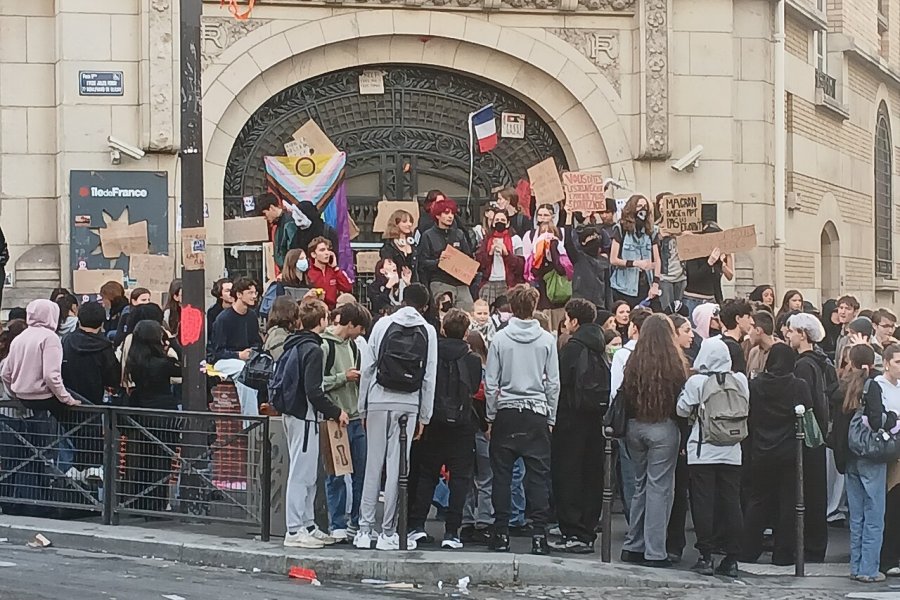
Highly skewed articles in French and international media focusing on images of burning rubbish bins overlook the most important aspect of the recent protests in the country – an explanation of what is actually happening in the protests by school students in France and why.
The French education system has long been in a state of deep crisis. While president Emmanuel Macron’s government has outwardly maintained a stance of supporting equal access to education, the reality is that the Ministry of Education’s budget has been shrinking year by year, jobs for both teaching and administrative staff are disappearing and controversial reforms are being implemented.
One such measure is the heavily criticised university admissions system known as Parcoursup. Its core innovation has been increased academic selection, which goes against established convention in France and which disproportionately affects students from socio-economically disadvantaged areas.
Student organisations and unions have long complained about undignified – and often inhumane – working conditions in some schools. There is a recurring shortage of teachers, particularly in key subjects such as French and mathematics. Rather than expecting colleagues to step in for sick or absent teachers, France relies on a formal pool of substitute teachers to fill the gap when needed.
However, working conditions and pay for supply teachers have deteriorated to such an extent that many are leaving the profession, resulting in cancelled classes and students falling behind on the curriculum. This situation primarily affects schools in smaller towns or disadvantaged areas, causing students to feel disadvantaged regarding future educational or career opportunities.
The most significant aspect of the student unrest is not the burning rubbish bins, but the strong intergenerational and class solidarity.
Some educational institutions struggle with a lack of teaching materials and poor maintenance due to their governing bodies lacking sufficient funds. Since most French regions experienced several extreme heatwaves last year, it became apparent that schools were completely unprepared for the consequences of the climate crisis. Consequently, the start of the new school year was expected to be marked by high tensions. These tensions culminated last week in a strike alert that gradually escalated into school blockades.
Young people left to fend for themselves
Student organisations have clearly stated their demands. They are calling primarily for increased funding for education so that young people can study in dignified and stimulating conditions, as well as for the adaptation of schools to the new climate reality. It is important to understand the nature of this generation. They are adolescents aged 14 to 16 – young people whose education was heavily disrupted by the Covid-19 crisis and who are coming of age in times of uncertainty, eroding social security and climate anxiety. As they themselves put it, they are constantly told they are the “future of France”, yet they feel largely abandoned.
Aurelio Cárdenas / Wikimedia Commons
French students have few avenues to express their dissatisfaction. The national education system is hierarchical and highly authoritarian and school is the place where pupils spend the majority of their lives from an early age. At the same time, the school system acts as an extension of the state and the French republican tradition, playing a pivotal role in shaping young generations. This makes the inability to draw attention to the system’s problems all the more frustrating. Consequently, the situation has reached a breaking point and students are resorting to tactics familiar from history – such as the protests of 1968, 1984 and 1998 – by blockading their schools and staging demonstrations.
And how does the state respond?
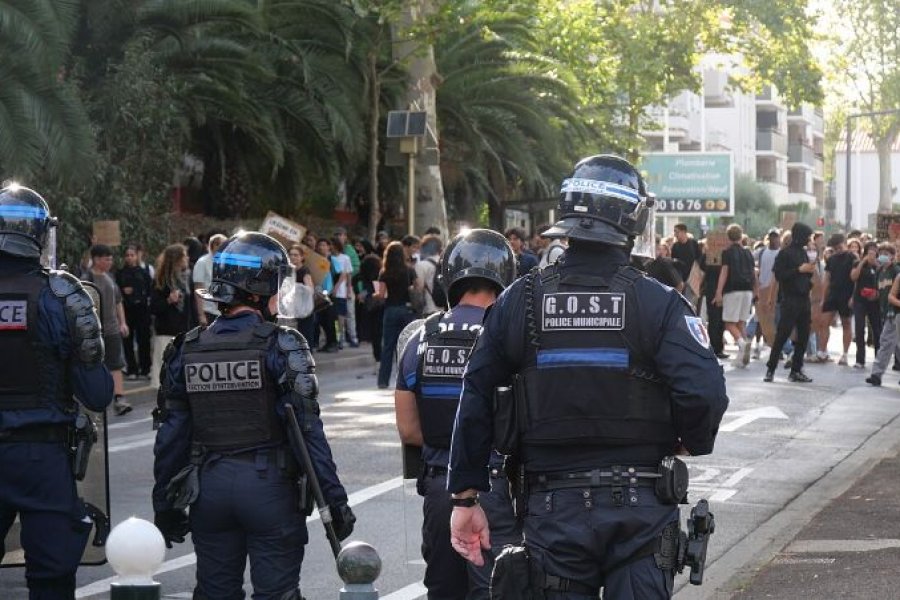
Instead of dialogue, the French government has sent riot police units against students – units that charge on horseback and which choke protesting students with tear gas. Thus, violence begets more violence. Yet, it is entirely legitimate to ask what exactly constitutes violence. A burning rubbish bin – yes, but unbearable heat in classrooms – no? Demonstrations involving firecrackers – yes, but police aggression – no?
A minority of protests have indeed escalated, and some images are truly heartbreaking. The burning of the Nelson Mandela High School in Nantes and certain attacks on police officers are disturbing examples. Yet these are isolated incidents that represent a tiny fraction of the protests as a whole. Most blockades are proceeding quite peacefully, with the active participation of teachers standing in solidarity with the students.
Intergenerational and class solidarity
The most significant aspect of the student unrest is not the burning rubbish bins, but rather the strong intergenerational and class solidarity. Social media is also being flooded with videos full of compassion and understanding, showing teachers forming human chains to protect their students from police units, or pensioners dancing with the protesters. Solidarity among students is also strong. A prime example is the symbolic participation of elite schools such as the prestigious Lycée Henri-IV in Paris, which decided to stage a blockade under the slogan “We are privileged and we want equal conditions for everyone”.
The Ministry of Education has announced plans to open a dialogue with students, however several hundred schools will simultaneously switch to remote learning on Monday as a precaution and a nationwide mobilisation of students and public sector workers supported by major trade unions is scheduled for Tuesday. Sophie Binet, head of the CGT confederation, has stated that the high school protests concern all public service workers.
The situation is also heavily influenced by the upcoming spring presidential election. Polls show left-wing candidate Jean-Luc Mélenchon leading decisively among young people aged 16 to 25. This trend is viewed with great displeasure by his opponents across the political spectrum, who are seeking simultaneously to exaggerate the violence of the protests, to argue that students are being directly controlled and manipulated by Mélenchon and to argue for increasingly repressive action by the state through the police.
In contrast, Mélenchon himself – uniquely among the declared major candidates for the 2027 elections – has expressed support for the school students, encouraging the wider populace to see their own children among the student protestors.
Everyone interprets these events in their own way, but our attention should focus primarily on young people, as their future is what matters most.
This article has been adapted for Left Field from an article published originally in Czech by Alarm.
Left Field · Contributor
Sára Vidimova

Sára Vidimova is a Franco-Czech writer and commentator based in the Picardie region of France. She was previously a Green candidate for the European Parliament in the Czech Republic where she writes about French and European politics for Alarm magazine.
Popular This Week



More to explore



Tell Google you want to see more from us - set Left Field as a preferred source in your search results.

