
Rent controls won’t wreck landlords, but record rents are wrecking renters
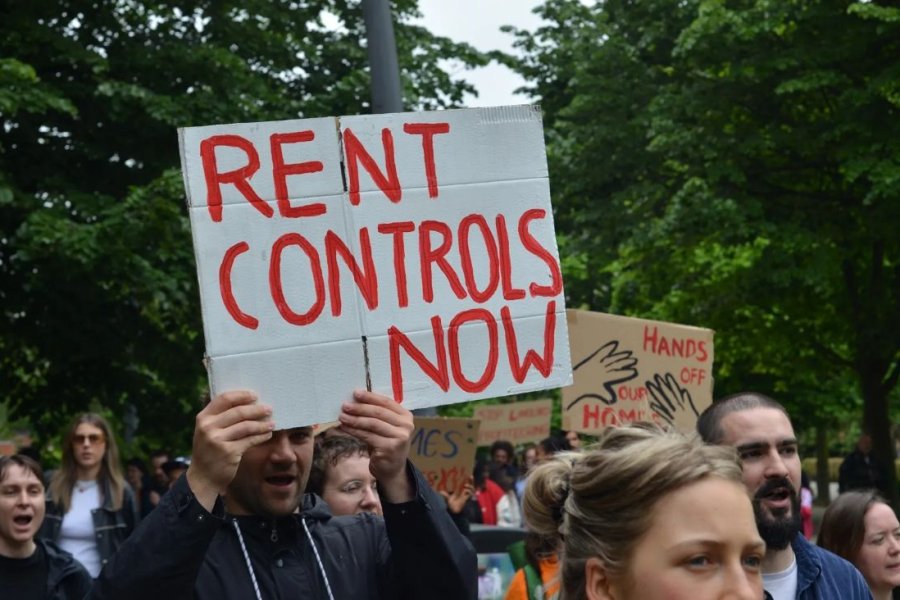
Despite Labour’s deputy leader ruling them out, the growing demand for rent controls from inside and outside the party is not going away. (Photo: London Renters Union)
Rents are at record highs and still rising. The landlord lobby says rent controls would wreck the market. The evidence says otherwise.
Every time rent controls come up, the same line gets trotted out – landlords are struggling too and capping rents would only make things worse. The National Residential Landlords Association has been warning of a “landlord exodus” for months. It’s a convenient story. It just doesn't survive contact with the numbers.
Let’s start with what renters are actually facing. The latest ONS figures show average rents in England rose 4% in the year to August, to £1,459 a month. Wales saw a similar rise, up 4.3% to £846. Scotland rose 1.1% to £1,013. London rents are now climbing faster than the south east, with the average renter there paying £2,332 a month.
None of this is new – rents have been rising for years. What has changed is that ministers have now ruled out doing anything serious about it. The Renters’ Rights Act, in force since May, bans no-fault evictions and rental bidding wars. It does nothing about the price itself. And in July, prime minister Andy Burnham’s own housing secretary, Angela Rayner, explicitly ruled out rent controls, telling the BBC the act was already having a “significant impact”.
That’s a striking reversal. As mayor of Greater Manchester in 2023, Burnham wrote to the then government demanding the power to freeze rents, warning that landlords were using the cost-of-living crisis to push through hikes. Fast forward to Number 10, and his government has done the opposite of what he once asked for. Zack Polanski called it “continuity Starmer”. Jeremy Corbyn called it “extremely disappointing”. Neither is wrong.
That’s the gap the landlord lobby’s “exodus” argument is designed to fill. And it’s worth testing against actual research, rather than taking it on trust.
A report from UCL’s Institute for Innovation and Public Purpose and the New Economics Foundation modelled what would have happened if rents had been frozen in November 2022. Their finding was that the government would still be saving an estimated £2bn a year in housing benefit spending, while only a small minority of landlords would have been pushed into unprofitability.
Rent controls would save money for renters
A 10% rent reduction, the equivalent of a two-year freeze from May 2024, would save the average renting household £1,300 a year. It would make 2.3% of individual landlords unprofitable, against the 4.8% already made unprofitable by tax and interest-rate changes since 2021. In other words, the tax and mortgage environment landlords already operate in is harder on their margins than rent controls would be.
Push the modelling further, to a 20% rent cut, and households renting privately would save around £2,400 a year. The report’s authors found mortgaged landlords would still be making profits more than four times higher than the average UK business under that scenario. Landlords without a mortgage, who make up the majority of the sector, would do even better. As the report's author, Dr Beth Stratford, put it, rent controls can offer immediate relief to struggling households while saving government money.
None of this makes the sums easy for every landlord in every circumstance. Nobody serious is arguing otherwise. But the industry framing, that any regulation of rents amounts to attacking landlords’ livelihoods and will simply drive them from the market, isn’t what the evidence shows. It’s a lobbying position dressed up as economic inevitability.
There’s also a simpler point buried under the modelling. The private rented sector is now the second-biggest form of housing in England, behind home ownership, housing around a fifth of all households. Left to the market, rents haven’t found some natural, sustainable level. They’ve kept rising, year after year, even as the supply of rental homes in some areas has grown. Waiting for housebuilding alone to fix this, which is broadly the current government’s position, means telling this year’s renters that relief is a decade away, if it comes at all.
A renewed campaign for rent controls is gathering pace precisely because the current settlement isn’t working for the people paying the rent and it now has an obvious political flashpoint. And that is that a prime minister asked for these powers himself, three years ago, and refused them the moment he could actually grant them. The landlord lobby can make its case all it wants, but it should expect to be called out when the actual figures don’t back up its PR spin.
In the meantime, the government really needs to start building the affordable council houses it has promised.
Left Field · Contributor
Left Field staff writers

This article was written by a staff writer or a group of writers from Left Field.
Popular This Week



More to explore


Tell Google you want to see more from us - set Left Field as a preferred source in your search results.

