NUJ calls for concrete action to save local news
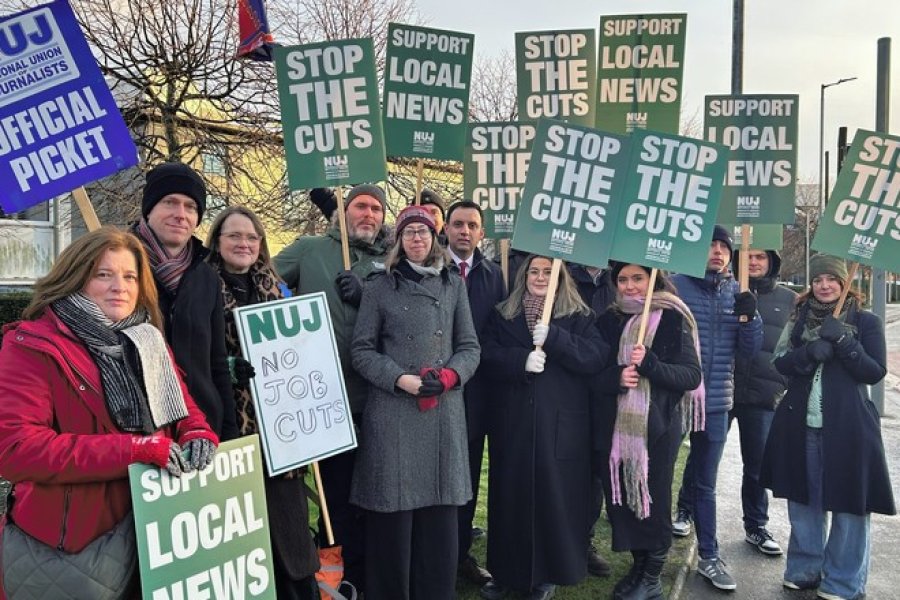
Members of the National Union of Journalists have been striking across the country against cuts in local newspapers.
A new grant scheme promises to prop up local journalism. The NUJ’s answer to what’s actually killing it – platform power, not just underfunding – goes much further than anything on offer from government.
Somewhere between the press release and the redundancy notice sits the government’s new Local News Fund. Announced by media minister Ian Murray on 7 July, it offers £12m over two years – £6 million in 2026-27 – to an industry that has lost around 300 local newspapers since 2005. Three quarters of the money will go directly to local outlets, in competed grants of up to £125,000, assessed by a steering board of “independent industry experts”.
Murray called it “an important step towards securing the future of local media across the UK”. He’s not wrong that something needed to happen. He is, on the evidence, wildly underselling the scale of what’s required.
The National Union of Journalists (NUJ) welcomed the fund, cautiously. General secretary Laura Davison noted the union has “campaigned for government grants to preserve and bolster local journalism” for years and called the announcement “recognition that the industry cannot be left to the vagaries of the market”. However, her statement did more than say thank you. Davison pointed out that millions of people across the UK now live in what the industry itself calls “news deserts” – places with no reporter left to cover the council chamber, the magistrates’ court, or the school fun day. £12m, she said, is “promising”, but she urged ministers “to do more to turn the tide”.
Her preferred mechanism is worth dwelling on, because it’s where the NUJ’s ask and the government’s actual policy properly diverge: a 6% windfall tax on the tech giants that, in her words, “dictate search traffic, gobble up advertising revenue and continue to profit” from journalism they don’t pay to produce. That’s not a modest ask for a modest top-up fund. It’s a structural argument about where the money that used to sustain local reporting actually went – into Google and Meta’s balance sheets – and who should be made to give some of it back.
Set the fund against what’s still happening in newsrooms and the mismatch gets starker. Iconic Media, formerly National World, has this year put 17 roles at risk of redundancy while closing its London World and Bristol World websites, part of a wider restructuring under new ownership. Ladbible Group has confirmed UK staff cuts as it “evolves” its operating model toward “brand-led IP” – corporate-speak for fewer journalists. Press Gazette’s ongoing tracker of 2026 job losses reads like a steady drip of managed decline, outlet by outlet, month by month. A competed grant fund distributing £6m a year is not going to reverse that trajectory. It might, at best, slow it in a handful of places lucky enough to win an award.
There’s a further complication that the government’s framing conveniently skips. Some of the pressure on independent and commercial local news is coming from inside the public sector. Media commentators have pointed to the BBC’s expansion of local text-based news – built partly from resources pulled out of BBC Local Radio – as directly competing with the same outlets the Local News Fund is meant to rescue. It’s hard to take seriously a local media strategy that funds local publishers with one hand while a publicly funded rival undercuts them with the other.
None of this means the fund is worthless. Grants of £125,000 will matter enormously to individual outlets fighting to keep a reporter on the council beat. But there’s a big difference between a lifeline and a strategy and the government has offered the former while calling it the latter. The NUJ’s own analysis – decades of decline, a market rigged toward platforms that pay nothing for the journalism they profit from, hundreds of titles already gone – describes a structural collapse. You don’t fix a structural collapse with a competitive micro-grant scheme reassessed every two years.
If ministers are really serious about local journalism’s democratic function – and Murray’s language about “scrutiny of decision-makers” suggests they at least understand the stakes – the honest next step is the one Davison has already put on the table – make the platforms that hollowed out local news pay to help rebuild it. Until that happens, £12m buys some breathing room. It doesn’t buy a future.
First published on theleftlane.media on 29 July 2026.
Left Field · Contributor
Left Field editors

This is the editorial team byline for Left Field. Articles may be written collectively or by one of our team of editors.
Popular This Week


More to explore



Tell Google you want to see more from us - set Left Field as a preferred source in your search results.

